One of the blogs I’ve been following lately is Hari Batti’s Green Light Dhaba which is very close to my heart. It seems that Hari talks about all things that I myself think about and I participate avidly in the discussions on his posts. And so I thought to myself, why not have a guest post from this great guy on my own blog? His is highly popular and my own poor creation gets some new readers as well pointing all my own subscribers and trespassers to a resource which is really going places. So I floated the idea to him, and he has kindly consented to spend his time and energy on a guest post for “Expressions”. Without further ado, here it is!
—————————————————————————–
It is a real pleasure to be guest posting here; I’ve enjoyed this blog a great deal since I found it a month or so back. I spend most of my time writing in Delhi at the Green Light Dhaba; I’d love to have you stop by there as well, some time.
Over the past few weeks, I’ve made fun of Delhi’s mega malls several times. That is because I think they are symbolic of much of what is wrong with India’s model of urban development. No matter how many basil plants Arjun Sharma, the director of Delhi’s Select City Mall, may have given away this Diwali, there is no escaping the fact that his mall is a disaster from an ecological and economic point of view.
I took my kids to the pair of monstrosities known as the Select City/MGF Metropolitan Malls and we did a little research a few weeks back. (And yes, I did have to compensate them with a round of over-priced iced teas. But I have never pretended to be perfect in matters of personal consumption.)

- MGF Metropolitan
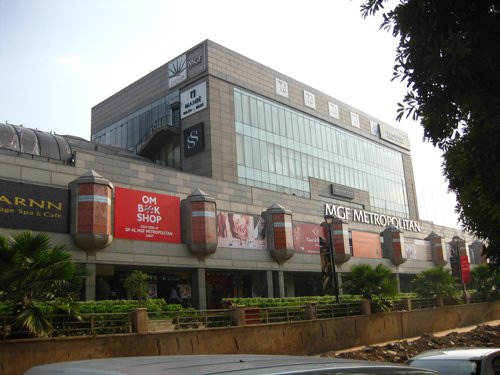
Here are some of the things we found. First of all, the positive side: malls are designed to make people giddy with excitement! It happened to my kids; it even happened to me, just a little bit.
Where does this feeling come from? Some of it is a result of the fact that suddenly we are in a “market” where we don’t have to jump out of the way of speeding two wheelers. But there are other things malls do to make you feel that way. Look at all the lights; feel the AC; ah, the spray of the water from the fountains. Scarcity has no place in a Delhi mall; neither do really poor people.
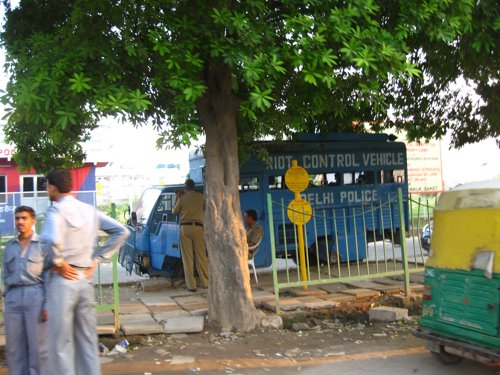
It is an intoxicating illusion–if you don’t think too much about what it costs to create and maintain it. (On the way out, I had to wonder whether the bright blue “Riot Control” van permanently parked on the road in front of the mall was part of how that illusion is enforced.)
Of course, the good feeling does not feel so good once you see the price tags of the goods being sold.
You see, high end malls are…expensive! The week before Diwali, Mint ran a big spread on holiday gift ideas. It included things like a Boombox for Rs. 4,199, an iPod for Rs. 11,200, and playing cards in a crocodile skin holder for only Rs. 36,000. This is the kind of stuff you will find in a high-end Delhi mall, and it is terrible for a number of reasons. Aside from the obvious issues of bad taste and dead crocodiles, there is the fact that much of what you find in a mall is imported. From an environmental point of view, that means that a whole lot of stuff had to be shipped a very long way–and shipping is a major source of global CO2 emissions. From the point of view of old fashioned economics, there is another problem caused by all those imported goods: a large part of the money spent at the mall goes straight out of the country. Which means it does very little in terms of creating jobs here. By contrast, when you buy locally grown food or locally made products in your local market, nearly all of the money you spend stays right here in the local economy.
But what about all those workers the mall employs, you ask? In fact, a mall is a very inefficient employment generator, because very little of the money spent in the mall goes to the workers who work there. Of course Arjun Sharma is not going to let me go over his books, but we did speak to one worker who sells brand name handbags ranging from Rs. 1000 all the way up to Rs. 4,200. She earns Rs. 4,500 a month. In other words, one hand bag sells for nearly as much as she earns in a month. If there is a sale on, this woman may sell as much as Rs. 35,000 worth of product over the course of one day. Malls promote the growth of overseas factories along with a few low wage local jobs. We can do better than that.
Speaking of employment, it’s not as if the people who do the work of building these malls will ever be able to shop in them; in fact, they live in horrible slums. One of these tent cities occupied the land right outside Select City for years while it was being built. Now it has moved down the road closer to where some other projects are being developed. So as not to offend shoppers, it is hidden behind a tall fence.
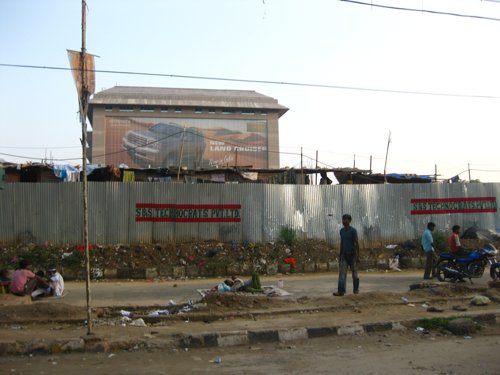
After seeing this, my 9 year old asked me this: “Instead of building another mall, why don’t the workers build homes for themselves?”
I tried to explain about how people who invest money to build things want to make more money, and they think building a mall will give them more profits than building homes for poor people. “It’s how the game works, son,” I said.
“But it’s not a game. It’s life,” was his answer.
There wasn’t much I could say to that, of course, because he was right; life is not a game and to use such metaphors runs the risk of trivializing things that are not trivial: poverty, environmental degradation, enormous unfairness.
A new mall, like over-consumption in general, is possible and profitable because we don’t pay the full cost of products from the mine to the dump. It is profitable because the monthly wages of the woman who sells you a handbag may not be equal to the price of the handbag itself. It is profitable because we allow the men, women and children who build our malls and our roads and our homes to live outside under tarps.
It will not be easy to encourage investment in sustainable development. Investors won’t change their behavior out of the goodness of their hearts. Somehow, we need to change what is profitable. We can start by strengthening and enforcing minimum wage laws. Then we can see to it that companies are not allowed to pollute for free; the full cost (including the cost of pollution and disposal) of all products should be reflected in their price tags. That will make a lot of stuff, especially stuff that is designed for the dump, more expensive. If we do this, we will have to consume fewer material goods; if we do it right, we can compensate by consuming more things that are sustainable: art, leisure time, good food, clean water etc.
Figuring out how to make all this happen will be a complicated business, but it’s not impossible, and it’s terribly important that we start soon. We need to change the way we do business; to do this we’ll to change the rules of the game. The rules of life.
HB
@Sakthi
One way of looking at it is that Malls increase the demand for these sort of goods and make them readily accessible in a nice place where rich people want to go.
Normally it takes effort to go to several places and pick up this stuff but when it’s concentrated and systematic like it is, shopping is so easy! Supply chains become easier to maintain for the stores and the whole process becomes scarily efficient.
@Sakthi Thanks for reading and responding. You are right, malls are not the only problem. But they are, I would argue, one end of the spectrum on this. There is nothing like a mega mall in Delhi to literally flatten the alternatives! The construction of Select City was an ugly process in itself — and a particularly costly one… and once built, malls become bubbles within which a particularly concentrated kind of over-consumption occurs. The rest of India is literally shut out. If I had the time, I'd argue more vigorously that the affect of this bubble on our minds causes it's own set of problems. And I'd suggest that even places like Khan Market, which are full of the same goods as Select City, would have a higher proportion of local goods–in part because they are not sealed off as effectively from the rest of the world.
But I don't want to get into all that, because I think we basically agree there is a problem and it is big, and there are many ways in which it will need to be tackled.
@Apu, you are absolutely right; it's not just the malls! The system we live in is designed to sell crap to people at all levels of society. I traveled 40+ hours twice by sleeper the summer before last and I saw an endless stream of poor vendors selling 10 rupee Chinese toys to families who would probably never shop at the mall. But the journey is long and hot, and any child can be amused by a cheap Chinese toy–until it breaks a few stops later! I think you are right; the market will not solve this one of it's own accord; they will need some…encouragement.
Why am I not totally convinced?
I never gave this much thought, but here are some observations.
The poor workers will not get homes if they stop making these malls, in fact they will be looking for work elsewhere. Malls are just another place they help to make where they do not live.
A mall workers working conditions are much better than most shop workers, even those who work in the wash rooms – they earn better and they generally respect these jobs as much as they respect a 'government job'.
Crocodile skin bags – will be sold from other outlets – I am totally against using animal products, but I am not sure if malls can be blamed for the use of animal products.
For many, malls become a very convenient place to shop or for leisure, a little like the Multiplexes. They are well organised, and I wish more of our markets were equally well organised.
Water fountains are not a malls-only phenomenon, and I hope the water is recycled (or should be). My only concern would be the air-conditioning.
In the beginning there were protests that malls will make the neighbourhood grocery shops go out of business. This did not happen, because the neighbourhood kirana guys learnt to provide efficient 'home delivery'. Perhaps the competition here will challenge our markets to get their act together?
But I totally agree that companies should not be allowed to pollute for free. And those who buy these products should pay for the damages.
@indianhomemaker
I'd just like to point out that kirana shops haven't yet gone out of business because malls haven't started providing really cheap groceries for the consumer.
In the US, Walmart devastates the local economy when it arrives, put hundreds of mom and pop stores out of business and generates more unemployment than it compensates for.
This is not to mention the fact that it's always located somewhat outside the suburb and people have to go in cars for longer distances to shop where previously they had to drive much less. No chance of folks walking or cycling though. In any case, people shop for so much at one time that they have to use a car to carry it all – no decent public transport in the suburbs.
Kiranas give people a chance to buy one thing at a time – step out for a soap, a toothpaste, and hopefully that will never ever change. We shouldn't become like consumers in other parts of the world.
Weshould create a socialist utopia where we can all practise barter system and live happily ever after.
@Metaempiricus
In my opinion, if history has taught us anything, it's that Utopias don't exist. Simple solutions which allow us to envision a paradise never quite work out. So I guess we need to fix what we have instead of trying to sacrifice everything and start over.
@indianhomaker, Sorry I didn't get back here; things got terribly busy in the non-blogging parts of my life.
There are no easy answer, of course. Malls do provide decent work for a lot of people; I'm not arguing otherwise. But what I'm arguing is that high-end malls are not an efficient employment generator; what's more, they do a lot of unsustainable import business; and they use a lot of resources themselves.
Bhagwad is right about Walmart in the US, from what I've read. So we have to be wary of the low end as well, I suppose.
Anyway, I'm not saying seal them up tomorrow. I'm not even really saying we should ban the construction of malls. But society should not directly or indirectly subsidize them. And like any industry, we should make sure that they are not allowed to pollute (either indirectly, or directly) and then expect the public to clean up after them.
What to do? I'm no urban planning expert, but here are a few ideas. Of course, these apply to businesses other than malls:
Malls put a load on local infrastructure and sewer; they need to pay for that.
Malls should not be allowed to eat up farmland, nor should they be given preferential treatment when it comes to land prices, etc.
The price of shipping and disposal needs to be included in the price of all imported goods, where ever they are sold. I suggest some ideas about how to do this over at the green light dhaba in my latest post on shipbreaking. But these, too are just sketches.
These are just a few ideas. But right now, I think our city fathers like to see malls come up because they make us look like we're World Class. (And I imagine there might be a few suitcases of cash being given out in the permiting process, but of course that's just the cynic in me talking!) Neither of those are good reason to build more malls!
@Metaempiricus: Well I don't want to say the advocates of socialist utopias have done no good work (they get partial credit for a lot of good things in Kerala, for example; and I know Cuban doctors have saved lives all over the world). But they didn't do very well with the environment in Bulgaria, from what I've heard. We need to evolve a new politics, I suspect. One that recognizes that being good to people and being good to the earth we live on cannot be mutually exclusive. It's going to take a lot of thinking, I think!
HB
Hari/Bhagwad,
Interesting blog post and observation. Wonder if malls are a true reflection of India’s globalization: media and digirati are excited about it but hardly impacts the aam admi?!