I’ve always wondered what parents find so adorable in sonogram images of the fetus that they have to carry it around in their wallets and phones. Maybe the realization that they are responsible for the creation of a life. That there in those photographs is a representation of themselves – their own DNA. Perhaps the closest to ever feeling that you’re a God. I don’t know, I’m just guessing.
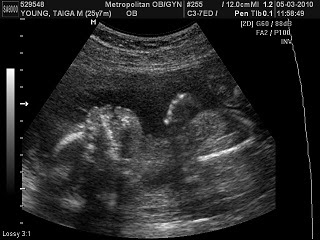
I have to confess though that I’ve always been kind of creeped out by the whole concept of a baby. Especially when it hasn’t been born yet. The sight of a person’s tummy bulging with a life form, sucking their nutrients out day after day…growing bigger and bigger until the time comes when the host’s body can’t contain it anymore. And then it rushes out, almost exploding into the world in a terrible crisis of pain, rupturing the body that fed it for 9 months. Brrr. Like something straight out of “Aliens”. And it doesn’t look too pretty when it emerges either. I get chills just thinking about it. There must be some kind of maternal instinct at work here because from a logical perspective, I would have just one thought were I a pregnant woman – “Get this thing outa me!!”
I mean is it just me, but does a fetus feel a hell of a lot like a parasite? Contributing nothing to the host organism, and making use of the sheltering body to sustain itself. Even after birth, it gets its emotional tentacles into the mother, drawing milk from her and emotionally blackmailing her into caring for it for the next ten or twenty years.
Now I know the formal definition of a parasite is that they have to from a different species. Also the birth of the fetus is just the beginning of its lifecycle. But these are just technicalities. In its very essence, we have one organism feeding on another. It’s not a symbiotic relationship with a give and take. It’s parasitic, pure and simple.
Does it matter? Probably not since people seem to enjoy having this thing growing inside them. Occasionally it some areas it becomes illegal to remove it after a certain stage. It’s just that it’s a whole new way of looking at the process and most people to whom I pitch this idea take a while adjusting to the notion, trying to square off their image of dangerous looking parasitic organisms like worms etc with the cute cuddly runts we see running around all the time. Hey, it is what it is!
I guess it also feels good to throw those off who believe that “life begins at conception” and that abortion is “killing babies”. I particularly enjoy the outrage when they sputter “How could you think that?” :D
i hate to go off topic, but can you prove there is no designER?
In reply to Western Point of View
You’re right it’s off topic. And it’s like asking to prove there’s no Santa Claus.
a) A parasite is defined as an organism of one species living in or on an organism of another species (a heterospecific relationship) and deriving its nourishment from the host (is metabolically dependent on the host). (See Cheng, T.C., General Parasitology, p. 7, 1973.)
b) A human embryo or fetus is an organism of one species (Homo sapiens) living in the uterine cavity of an organism of the same species (Homo sapiens) and deriving its nourishment from the mother (is metabolically dependent on the mother). This homospecific relationship is an obligatory dependent relationship, but not a parasitic relationship.
a) A parasite is an invading organism — coming to parasitize the host from an outside source.
b) A human embryo or fetus is formed from a fertilized egg — the egg coming from an inside source, being formed in the ovary of the mother from where it moves into the oviduct where it may be fertilized to form the zygote — the first cell of the new human being.
a) A parasite is generally harmful to some degree to the host that is harboring the parasite.
b) A human embryo or fetus developing in the uterine cavity does not usually cause harm to the mother, although it may if proper nutrition and care is not maintained by the mother.
a) A parasite makes direct contact with the host’s tissues, often holding on by either mouth parts, hooks or suckers to the tissues involved (intestinal lining, lungs, connective tissue, etc.).
b) A human embryo or fetus makes direct contact with the uterine lining of the mother for only a short period of time. It soon becomes isolated inside its own amniotic sac, and from that point on makes indirect contact with the mother only by way of the umbilical cord and placenta.
a) When a parasite invades host tissue, the host tissue will sometimes respond by forming a capsule (of connective tissue) to surround the parasite and cut it off from other surrounding tissue (examples would be Paragonimus westermani, lung fluke, or Oncocerca volvulus, a nematode worm causing cutaneous filariasis in the human).
b) When the human embryo or fetus attaches to and invades the lining tissue of the mother’s uterus, the lining tissue responds by surrounding the human embryo and does not cut it off from the mother, but rather establishes a means of close contact (the placenta) between the mother and the new human being.
a) When a parasite invades a host, the host will usually respond by forming antibodies in response to the somatic antigens (molecules comprising the body of the parasite) or metabolic antigens (molecules secreted or excreted by the parasite) of the parasite. Parasitism usually involves an immunological response on the part of the host. (See Cheng, T.C., General Parasitology, p. 8.)
b) New evidence, presented by Beer and Billingham in their article, “The Embryo as a Transplant” (Scientific American, April, 1974), indicates that the mother does react to the presence of the embryo by producing humoral antibodies, but they suggest that the trophoblast — the jacket of cells surrounding the embryo — blocks the action of these antibodies and therefore the embryo or fetus is not rejected. This reaction is unique to the embryo-mother relationship.
a) A parasite is generally detrimental to the reproductive capacity of the invaded host. The host may be weakened, diseased or killed by the parasite, thus reducing or eliminating the host’s capacity to reproduce.
b) A human embryo or fetus is absolutely essential to the reproductive capacity of the involved mother (and species). The mother is usually not weakened, diseased or killed by the presence of the embryo or fetus, but rather is fully tolerant of this offspring which must begin his or her life in this intimate and highly specialized relationship with the mother.
a) A parasite is an organism that, once it invades the definitive host, will usually remain with host for life (as long as it or the host survives).
b) A human embryo or fetus has a temporary association with the mother, remaining only a number of months in the uterus.
A parasite is an organism that associates with the host in a negative, unhealthy and nonessential (nonessential to the host) manner which will often damage the host and detrimentally affect the procreative capacity of the host (and species).
A human embryo or fetus is a human being that associates with the mother in a positive, healthful essential manner necessary for the procreation of the species.
[This data was compiled by Thomas L. Johnson, Professor of Biology, Mary Washington College, Fredericksburg, VA. Professor Johnson teaches Chordate Embryology and Parasitology.
Sorry, i clearly remember this from my parasitology classes and kept this on the side.
Technicality? Yes, but you are discussing science and science is all about technicalities.
In reply to Western Point of View
It’s still a technicality. Irrelevant.
Also remember that for most of human history, childbirth was the leading cause of death for women.
In reply to bhagwad
H20 is water. H202 is hydrogen peroxide.
Technicality? Sure. But try drinking hydrogen perxodide and see what happens.
Sure, replication of an organism leads to death quite a bit. Viruses replicate themselves pretty often. 20-30% of viruses die in the process of replication, yet they still do it.
how so? Why would a virus go through so much trouble, like a human being, to replicate itself?
Again, study your evolutionary biology.
In reply to Western Point of View
There are important technicalities and unimportant technicalities.
I think the “same species” argument is an unimportant technicality. Peroxide and water is an important technicality.
And please, please strop attributing intentions to viruses. They’re just strands of RNA surrounded by some protective material.
A parasite is a type of symbiont. Symbiosis, by a generally accepted definition can be of 4 types: mutualism, parasitism, amensalism and comensalism. You can also add Synnecrosis.
A fetus is not a parasite. Why? simple. because a parasite, by definition, brings absolutely no advantage to the host. Whereas a fetus brings the highest advantage possible to the host: it directly increases it’s fitness, by allowing the host to pass it’s genes forward.
Survival of the fittest? Again, we aren’t talking about individuals. We are talking about species. Of course a species as a whole cares if it survives or not.
Again, can a species exist without it being able to reproduce?
In reply to Western Point of View
A species cannot “care” about anything. Passing on genes brings no benefit to the individual.
And for the last time – please don’t repeat points already dealt with elsewhere by us.
In reply to bhagwad
Oh, figured I’d throw this in there… Family, community, society, that’s what people get in return for a carrying a fetus. Not a fuzzy warm ‘I love you’ emotional feeling, but help. production, innovation, technology, video games, this site. One man may be able to fell a tree, doubtful would be able to drag it out of the woods. 10 men could fell 10 trees a day and drag them out of the woods, while 10 others would have made their tools, furnishings, and food for everyone involved.
In reply to Balrog
You can get all that without carrying a fetus yourself :). Just let others do it for you!
In reply to bhagwad
Why do other animals (besides human beings) go out of their way over reproducing? If they didn’t care about the gene pool, why would animals, viruses, salamanders (who clone themselves essentially), bacteria, amoeba reproduce?
In reply to Western Point of View
Umm…it feels good? Do they need another reason?
Viruses do not have brains. Bacteria do not have brains, therefore the “feel good” part of the brain (ie the pleasure section or whatever you’d like to call it) does not exist.
Amoeba and paramecia mate just like we do, yet they have no brains. They cannot “feel good.”
The only few animals that can feel pleasure are dolphins, some primates, and domesticated animals such as dogs and cats. Even that is maybe 100 fold less than the most primal human being.
So how can a bacteria feel good if it doesn’t have a brain again?
In reply to Western Point of View
Viruses don’t have brains….but they’re smart enough to know about genetics?
What are you saying?
In reply to bhagwad
they aren’t smart to know about genetics.
Through evolution, viruses replicate successfully in order to ensure their species survive. Do they know it? absolutely not. They simply “do what they were evolutionary designed to do.”
Again, why would viruses go through all the trouble of replicating if 20-30% of them die in the process, just like human mothers?
How can any organism “feel good” if they have no central nervous system?
Why else do we see so many viruses (rhinovirus, HIV, dengue, West nile etc.) keep on surviving? They don’t “feel good” right?
In reply to Western Point of View
I don’t even consider a virus a living creature. It’s just a robot mindlessly going about whatever it does.
Neither does it mate. It doesn’t carry a fetus, so the question of parasites doesn’t even occur. This conversation is over until you start making some more sense…
RNA viruses are retroviruses. DNA strands of viruses also exist. Not all viruses are surrounded by “protective material.” Again, get the biology right.
What about other eukaryotes? We are human beings and are eukaroytes. So are fungi. Fungi actually shares quite a bit with us, yet they lack a central nervous system.
What about fungi? They are eukaroytes.
Viruses, gorillas, fungi, bacteria and humans all INATELY reproduce. Through millions of years of evolution, species have been designed BY EVOLUTION to ensure the survival of their own species.
BTW, obviously viruses aren’t just “RNA in protective material.” That very definition can tell me a plastic tube containing RNA is also a virus, since the “protective material” is the plastic.
Again, you’ve got to know the biology.
If viruses are only “RNA” (btw, there are plenty of DNA viruses out there such as smallpox, chicken pox, etc.
Again, a virus is a species. They have a genome and replicate and occupy ecological niches, just like humans.
And just like humans, viruses innately reproduce themselves. You can’t argue with billions of years of evolution.
In reply to Western Point of View
Wake me up when viruses and eukaryotes carry fetuses. I’m trying very hard to not admonish you for not staying on topic and straying into irrelevancies. There are enough opinions stating that viruses are at the “edge” of life. They don’t even have their own reproductive mechanism.
I can argue about viruses. Strictly speaking I don’t consider even plants to be “true” life. I view them as robots. But that’s neither here, nor there.
This post is about fetuses. Stick to species that carry them, or else I’ll have to remove the comment.
In reply to bhagwad
we are eukaryotes. WE carry fetuses.
Carrying a fetus is how we randomly, by evolution, replicate our DNA. Instead of cloning ourselves, we have a sperm and an egg. The egg is fertilized by the sperm, providing us the gene pool of two different people.
Why aren’t viruses living? Because they lack a central nervous system?
I can argue that animals also are mindless robots that go about whatever they do.
Do animals replicate their DNA? Yes
Do viruses replicate their DNA? yes
Do animals have genomes? Yes
Do viruses have genomes? Yes
Do animals comprise an ecological niche? Yes
Do viruses comprise an ecological niche? Yes
So what about fungi? They are eukaryotes, just like us.
What about amoeba? They mate.
You’ve gotta start making biological sense.
Again, the above reasons are EXACTLY why a fetus isn’t a parasite–it is merely our form of genome replication.
In reply to Western Point of View
There is no “we”. There is no “our”. There’s no grand plan for a species to survive. Every animals is an individual and lives for its own personal benefit. It doesn’t care about genes, or survival of the species. It just does what feels good for itself at any given moment.
Show me how an individual organism benefits from a fetus and then we’ll talk.
In reply to bhagwad
btw, no animal cares about genes, species etc.
This is evolutionary design. Billions of years of evolution.
The animal DOESN’T care individually about anything. They are simply surviving.
Just like a virus. Just like amoeba. Just like fungi. Just like human beings.
We are evolutionarily designed to replicate our genomes.
Why else would we have the ability to reproduce?
Survival of the fittes, right?
In reply to Western Point of View
Lol – you’re contradicting yourself. You admit that no one cares about genes or genetics.
“Why else would we have the ability to reproduce?”
Again you’re assuming some grand purpose. It’s called teleological thinking and is widely accepted as a fallacy.
so let me get this straight.
As a scientist, let me tell you that animals are simply replicating their genomes.
Animals replicate themselves because they “feel good” while other organisms do it because “they just do what they do?”
If anyone isn’t making sense, it isn’t me.
Humans are replicating their genomes. This is why they go through the trouble of carrying a fetus.
Through billions of years of evolution, our method of replicating our genomes has survived and is fit. how so? We’re still alive as a species.
Again, do you know how evolution works?
Fetus=form of replication, therefore not a parasite.
In reply to Western Point of View
Humans are replicating their genomes. This is why they go through the trouble of carrying a fetus.
Hunh. I guess before we knew about genomes, humans never replicated.
Oh wait…
In reply to bhagwad
no we didn’t know about this.
Haven’t you heard of “survival of the fittest?”
definition of fitness” ” Fitness is the ability to both survive and reproduce, and is equal to the average contribution to the gene pool of the next generation that is made by an average individual of the specified genotype or phenotype. If differences between alleles of a given gene affect fitness, then the frequencies of the alleles will change over generations; the alleles with higher fitness become more common”
Rest of comment deleted for not sticking to topic.
I’m deleting part of your comment because I warned you to only talk about organisms that can carry fetuses.
The rest of your comment has no relevance.
there is no grand purpose asides from evolution.
that is it.
that is why scientists, like myself, don’t consider teh fetus a parasite.
We replicate our genomes by having babies (ie all mammals)
So do lions.
you can consider things all you want. You can consider the sky to be the color green, but the fact is it isn’t. Not all animals possess the capability to “feel good.”
Again, fetuses are a form of genome replication. Billions of years of evolution have led us to replicate our genomes like we do today. It works for us. Just like laying eggsg works for birds. They are still alive.
There is no purpose. We are simply a species recreating ourselves. You said this yourself. It is just the way of evolution.
In reply to Western Point of View
“We replicate our genomes by having babies (ie all mammals)”
But you don’t have babies in order to replicate your genomes. You have sex because it feels good. That’s it.
why not? Fetuses are simply OUR way we replicate our DNA. It works for us. We are fit as a result of it.
Sponges are animals. We are animals. Sponges replicate. We replicate.
Obviously, sponges do not have fetuses. Why? IT doesn’t work for them. Evolution didn’t design them that way. We have fetuses. It works for us. We are fit as a result.
Therefore, fetuses are not parasites, as they ensure our fitness.
In reply to Western Point of View
So you agree with me that fetuses don’t benefit the host?
In reply to bhagwad
no they do benefit the host. They ensure the hosts’ species survives.
We replicate our DNA. How? We have babies.
Viruses replicate their DNA. How? Viral DNA/RNA replication.
Sponges replicate their DNA. how? Budding.
Guess what–all of those above mentioned forms of genome replication works for the species at hand. We have fetuses. We successfully replicate our genomes. Fetuses benefit the host–the host species survives and remains fit.
If fetuses in 1 million years do not work, guess what? We die off or evolve by having another form of genome replication. Maybe we’ll start laying eggs. Who knows.
All we know is that having a baby the way we do works. We have 7 billion of our species living and thriving and even changing the environment in our way. Fetuses successfully replicate the hosts genome and therefore, provide fitness and a clear benefit.
Fetuses are not parasites. They ensure the fitness of the human (and or other mammal besides duck billed playtapus) species.
WE are eukaryotes, btw. We are animals btw. Sponges are also animals, who do not have brains.
In reply to Western Point of View
“Host species survival” is not the same as benefiting the host. You think an animal cares if its species survives or not?
So again – you agree with me that a fetus is a parasite that doesn’t benefit the host.